
Defective Airline Food Lawsuits: What Injured Passengers Need to Know
The holiday season is rapidly approaching. For many Angelenos, that means one thing: air travel. As you book those coveted first-class seats or settle in for an international journey, you anticipate safety, comfort, and perhaps a decent meal. Yet, amidst the hustle of holiday travel, a dark trend is emerging. Passengers are suffering severe injuries from defective and contaminated airline food and beverages.
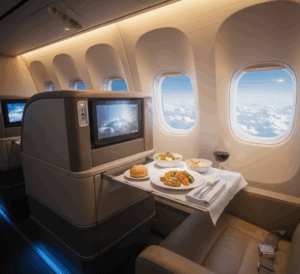 Airlines sell safety and comfort. However, their food service systems rely on massive, fast-paced catering operations. These operations are highly susceptible to dangerous, often negligent, errors. When you bite into an airline meal or accept a beverage, you assume it’s safe. What happens when it’s not?
Recent personal injury cases against major airlines prove that food and beverage incidents create serious liability risks. If you suffer an injury on a flight originating from or landing in a major hub like LAX, you need a local California attorney. Your lawyer must understand both product liability and the specialized realm of aviation law.
The Shocking Spectrum of Airline Food Liability
The threat to passengers goes beyond simple food poisoning. It covers a spectrum of product failures from foreign objects to dangerous temperature negligence. Modern airline food litigation generally falls into three high-risk categories:
1. The Foreign Object Defect: When Fine Dining Hides Danger
In one chilling account, a passenger on a first-class flight bit down on a sharp, metallic object. The object hid deep within their duck meal. The resulting dental and internal trauma was immediate and severe.
This represents a classic manufacturing defect case. A piece of equipment or debris entered the food during mass catering. The injury itself, a fractured tooth or laceration, provides direct evidence of a defective product. The airline remains strictly liable for placing that dangerous product into the hands of the passenger. This holds regardless of its contract with the catering company.
2. Temperature Negligence: The “Too Hot” and “Too Cold” Claims
A growing number of lawsuits focus on the extreme and unsafe temperatures of items airlines serve in-flight. This category encompasses two distinct and dangerous forms of negligence:
The “Too Cold” Case (Dental Fracture):
A passenger recently sued a major carrier after allegedly fracturing her tooth on an ice cream sandwich. Airlines served the dessert “frozen solid.” The lawsuit claimed the dessert reached a temperature so low it made the treat dangerously hard. This illustrates a clear failure to warn. It also demonstrates negligence regarding safe serving temperatures.
The “Too Hot” Case (Severe Burns):
A more common, but equally horrific, incident involves scalding burns from spilled hot tea or coffee. In multiple recent lawsuits, passengers have suffered severe burns. Crew members spilled excessively hot liquids, often during turbulence or while navigating narrow aisles. These incidents resulted in second-degree burns, disfigurement, and prolonged pain.
Plaintiffs accuse airlines of negligence for serving liquids at temperatures exceeding reasonable safety standards. Airlines also failed to use proper spill-prevention lids or adequate warnings.
These varied but dangerous incidents establish a pattern. Whether the injury stems from a foreign object, extreme temperature, or contamination, the airline bears the legal responsibility.
The Lawsuit That’s Forcing Airlines to Re-think Safety
The most significant and shocking recent case demonstrates the catastrophic failure of catering quality control. A passenger sued a major carrier after suffering a severe injury from a piece of wire hidden in an in-flight meal.
In a 2024 lawsuit, passenger Bastian Bromse claimed that during a flight from Washington D.C. to Berlin, he swallowed a piece of metal wire. The wire hid in his airline-provided meal. The wire became lodged in his throat. Doctors performed an emergency medical procedure to remove the foreign object. This caused “severe discomfort and pain.”
If you’re wondering why this particular incident is making such massive waves in the legal and aviation communities, it boils down to accountability. This isn’t a minor incident. It’s a catastrophic failure of quality control. Finding a sharp piece of metal in your food represents an unequivocal safety failure. Basic measures like industrial metal detection at the catering facility should have prevented this.
For injured passengers, this case highlights something crucial. Under the Montreal Convention, which governs international flights, you don’t necessarily have to prove the airline acted with gross negligence. You only need to prove that the injury resulted from an “accident”, an unexpected, external event, that happened on board. Being served a razor-sharp wire in your dinner perfectly fits that definition.
The legal pressure from lawsuits like Bromse’s should, and must, force airlines to enforce more rigorous food safety checks. These checks must be independently verified across their entire global supply chain. This is about changing corporate behavior for the safety of every passenger. This becomes particularly critical as airlines utilize more high-risk, outsourced catering for the surge in holiday travel.
Official Resource Link: For more on the specifics of this and similar aviation food injury claims: Man sues United Airlines after metal wire in meal gets lodged in throat.
Your Rights After an Airline Food Injury: The Legal Framework
If airline food injures you on a flight, whether over the continental U.S. or internationally, you have legal recourse. You can pursue claims under California’s product liability laws and/or international conventions.
For international flights, the Montreal Convention establishes strict airline liability. Airlines face liability for injuries a passenger sustains due to an “accident” that occurred on board. This liability extends up to a significant financial limit (currently equivalent to approximately $170,000).
In these cases, your attorney will argue that the incident constitutes an external “accident” that caused your bodily injury. This includes a hidden object or a dangerously hot spill caused by turbulence. The airline then bears the heavy burden of proving it was not negligent to avoid full liability.
Protecting Your California Claim: Immediate Steps
For any food-related injury, especially those involving a manufacturing defect like a sharp object, immediate action is paramount:
- Stop Eating and Save the Evidence: Do not discard the remaining food or the foreign object. This item represents the single most important piece of evidence in your case. Place it immediately in a clean napkin or container.
- Document the Scene: Take photos of the meal, the object, the packaging, and your injury. If you suffer burns, photograph the redness, blistering, or scarring immediately.
- Report the Incident: Immediately notify the flight crew. Insist that they document the incident in the flight log. Ask for a copy of the report, or at least the report number.
- Seek Medical/Dental Care: Get a thorough examination immediately upon landing. Obtain a written medical record linking your injury directly to the consumption of the in-flight food or beverage.
- Contact a Product Liability Lawyer: Due to the complexities of aviation law, catering contracts, and product liability statutes, you need a California attorney. Your lawyer must have experience taking on major airlines.
If a product failure in the cabin derailed your journey, you deserve compensation for your pain, suffering, and medical expenses. Don’t let a major airline minimize your injury.
Official FDA Guidance on Foreign Objects in Food: CPG Sec. 555.425 Foods, Adulteration Involving Hard or Sharp Foreign Objects
Call Now for a Free, Confidential Case Evaluation
Call Now: 888-712-0017. Howell Law Firm PC